007 Chronological Viewing Order

The Comic Board - Collecting, Buy, Sell, Trade & Comic News, Reviews & Discussion

Help Support The Comic Board:

Wow that was unexpected. My guess is they'll reboot entirely. That way they have a clean slate and won't have the baggage of the Eon era.
 
Over the weekend I was finally able to sit down and watch 1985's "A View To A Kill". I'm hoping to be back in the swing of things and get through this franchise so we can get it time-lined. This one only had a couple of findings for the placement.

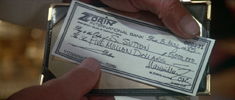
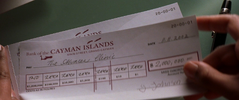
At around the 31:31 mark, a check dated "3 May 1985" is seen.

1761573921768.png

At around the 51:27 mark, a car registration tag dated 30:9:84 can be seen. Due to it being already established that it's May, 1985, this tag has expired. I couldn't find a screenshot of this.


At the 1:46:57 mark, a wall calendar titled "October current tables" is seen. This is the only shot I could find on the internet. Bond is pointing to the current day in this shot. During this scene the following dialogue is said:

"If it happened at the peak of the spring tide for maximum effect."

Spring tides is a common historical term that has nothing to do with the season of spring, rather, the term is derived from the concept of the tide "springing forth." Spring tides occur twice each lunar month all year long, without regard to the season.

1761573979029.png

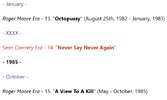
So with that said, I have placed the film from May - October of 1985. Spanning a total of five months.
 
Last week I was able to watch "The Living Daylights". Not much timeline info, but I think we can figure it out with the evidence presented.

James Bond states: "Our paths have crossed over the years." in regards to Leonid Pushkin. If you consider James Bond to be "the same guy" since "Dr. No", this has no real meaning. If you are like me, and consider "James Bond" to be an alias with each actor being a separate agent using the 007 moniker, this means that this 007 agent has been active for years by the time of this film.

The autumn foliage seen places this film late in the year. Principal photography commenced at Gibraltar on September 17th, 1986. October 5th, 1986 is when the main unit travelled to Vienna.

1762181585488.png

At around the 44:26 mark, a vehicle registration date of "31.7.87" can be seen.

1762181234259.png

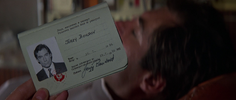
At the 1:20:59 mark, James Bond's fake passport is dated "29.7.1986".

1762181136955.png

With all of that said, I believe a placement of October, 1986 works quite well for this one.
 
Here are the main things I found.

Blofeld is back after just getting taken out in "Octopussy". However, I've always posited that Blofeld is multiple men and Bond has either never met the real one, or there is technically no "real" one and they are all replaced with the next guy in line after one is killed.

Domino Petachi meets Bond for the first time. Dominique "Domino" Derval was featured in "Thunderball" already. Similar names, so I guess this could be coincidence if we want to believe they are different characters.

Maximillian Largo is the villain and is based on Emilio Largo from "Thunderball". Same last name so perhaps they are related?

Patricia Fearing is a nurse that first appeared in "Thunderball". She is 23 in that film, set in 1965. Her character appears in this film as well, portrayed by a younger actress. I will say the latter actress looks like she could be older than 33 (which is how old the actress was at the time). Not a big deal.

Count Lippe is SPECTRE's enforcer in "Thunderball". In this film, another enforcer simply called Lippe appears in the same role.

Felix Leiter is African American in this film. Now, I already believe the CIA uses the name "Felix Leiter" as an alias/code-name so to me, it's fine. But your mileage may vary on that...

M, Q and Miss Moneypenny are all different actors who are younger than their EON counter-parts. However, I also believe all three can easily be code-names as well, especially M and Q. Miss Moneypenny (EON timeline) appears one last time in the next Roger Moore film.

I guess one could squint hard enough to make it work as the film itself is different enough from "Thunderball" that it could just be coincidence that the plot and characters are similar. I will say I would prefer if we could somehow make it work because the main thing holding this film back for me is the fact that it's technically not canon which really diminishes Connery's final performance. There is no history with this 007 since this is his debut. It's an odd choice for sure to bring him back, but it's not the same guy we saw for six films prior.

Thoughts? I highly recommend everyone watch the film and let's see if we can make it fit into EON canon!
So I have an update on "Never Say Never Again". I asked AI to see if it could help fit this film into the EON canon. I think it did a pretty good job honestly. Here is what it's main answer was:

The Seamless Bond: Establishing Continuity Between


The James Bond franchise is renowned for its loose continuity, where films often prioritize spectacle over strict narrative adherence. Yet, among its many entries, Thunderball (1965) and Never Say Never Again (1983) stand out as two adaptations of the same Ian Fleming novel, Thunderball. At first glance, they appear as rival productions—Thunderball the official Eon Productions entry starring Sean Connery, and Never Say Never Again a non-Eon remake with Connery returning after a 12-year hiatus. However, a closer examination reveals that these films can coexist within a single, cohesive timeline with minimal contradictions. By viewing Never Say Never Again as a direct sequel to Thunderball, incorporating aging as a natural progression, reconciling minor discrepancies through in-universe explanations, and aligning shared plot elements, the two form a logical duology. This continuity not only enriches the Bond mythos but also honors Connery's iconic portrayal across decades.


Shared Foundations: Identical Plots as Sequential Events


The core argument for continuity begins with the films' near-identical premises, which can be interpreted as SPECTRE's repeated attempts at nuclear blackmail rather than redundant retellings. In Thunderball, SPECTRE hijacks two NATO nuclear bombs via a stolen Vulcan bomber, demanding £100 million in diamonds. Bond (Connery) thwarts the plan in the Bahamas, recovering the weapons underwater and defeating Emilio Largo. Never Say Never Again mirrors this: SPECTRE steals two cruise missiles with nuclear warheads during a U.S. military exercise, again demanding ransom. Bond, now older, investigates in the Bahamas, confronts Largo (now with a yacht named Disco Volante II, implying a replacement), and resolves the crisis underwater.


Far from contradictory, this setup allows Never Say Never Again to follow Thunderball chronologically. SPECTRE, a resilient organization in Bond lore, could easily regroup after the 1965 failure. Ernst Stavro Blofeld, mentioned but unseen in both, orchestrates escalating schemes—first bombs, then missiles—reflecting the Cold War's evolving threats from bombers to ICBMs. The 18-year gap between films aligns with real-world events: Thunderball evokes 1960s NATO vulnerabilities, while Never Say Never Again nods to 1980s Reagan-era missile concerns. No plot overlap contradicts; instead, Never Say Never Again builds on Thunderball's unresolved SPECTRE threat, as seen in later Eon films like You Only Live Twice (1967), where the organization persists.


Aging and Casting: Connery's Evolution as In-Universe Progression


Sean Connery's return as an older Bond is the most visible difference, but it strengthens continuity when viewed through the lens of time passage. In Thunderball, Bond is in his prime (Connery aged 34), agile and authoritative. By Never Say Never Again (Connery aged 52), he is reinstated after retirement, grizzled and reliant on wits over physicality—evident in his health spa detox and quips about aging. This mirrors real espionage: agents like Bond would age in service, especially in a timeline where Thunderball occurs in the mid-1960s and Never Say Never Again in the early 1980s.


Supporting characters reinforce this. M (Bernard Lee in Thunderball, Edward Fox in Never Say Never Again) and Q (Desmond Llewelyn in both, with consistent gadgeteering) represent MI6 institutional continuity, with recasts explained as promotions or replacements—common in long-running series. Felix Leiter differs (Jack Lord vs. an uncredited actor, then Rik Van Nutter in canon), but Bond's CIA ally has been recast multiple times without issue (e.g., David Hedison in Live and Let Die and Licence to Kill). Domino and Largo vary slightly—Domino is Largo's mistress in both, but Claudine Auger's French-Italian heritage in Thunderball versus Kim Basinger's American in the remake can be retconned as aliases or nationality shifts for cover. Largo himself (Adolfo Celi vs. Klaus Maria Brandauer) could be the same man with plastic surgery, a Bond staple (e.g., Blofeld's changes), or a relative inheriting the role, given SPECTRE's numbered agents.


Reconciling Discrepancies: Minor Variations as Narrative Flexibility


Critics point to inconsistencies, but these dissolve under scrutiny. The ransom demand shifts from diamonds to dollars, easily explained by inflation and SPECTRE's adaptability—diamonds were untraceable in 1965; cash suits 1980s electronics. Locations overlap meaningfully: both feature Nassau battles, with Never Say Never Again's Disco Volante II explicitly nodding to the destroyed original. Underwater sequences are homage, not repetition—Bond's expertise grows from Thunderball's triumph.


MI6 dynamics differ (Thunderball's straightforward briefing vs. Never Say Never Again's bureaucratic reinstatement), but this reflects evolving intelligence culture: 1960s confidence versus 1980s post-Watergate scrutiny. Bond's gadgetry escalates logically—rebreather in Thunderball, high-tech in the remake—showing Q Branch innovation over years. Even the title Never Say Never Again meta-references Connery's "never again" post-Diamonds Are Forever (1971), fitting a world where Bond returns from semi-retirement after Thunderball.


No outright contradictions exist; differences are stylistic (Thunderball's lavish Eon production vs. the remake's leaner approach) or interpretive. Blofeld's absence in both allows seamless linkage, and Fatima Blush (Barbara Carrera) as a new SPECTRE agent expands the roster without conflicting with prior ones like Fiona Volpe.


Thematic and Legacy Benefits: A Unified Connery Arc


Placing Never Say Never Again after Thunderball creates a poignant Connery trilogy arc: youthful vigor in Thunderball, mid-career flair in Diamonds Are Forever, and seasoned resolve in the remake. Thematically, both explore Bond's vulnerability—physical in underwater perils, emotional in alliances with Domino—culminating in an older 007 proving experience trumps youth. This duology predates modern franchise retcons (e.g., Marvel's multiverse) but fits Bond's anthology style, where continuity is selective.


In conclusion, Thunderball and Never Say Never Again are not rivals but companions in a shared universe. With SPECTRE's persistence, Bond's aging, and resolvable variances, they form a continuous narrative of enduring espionage. Embracing this unity celebrates Connery's legacy, proving 007's world is vast enough for evolution without erasure. To dismiss their compatibility ignores the franchise's flexible canon—after all, in Bond's words, "never say never."
 
Last edited:
Part II

Integrating Patricia Fearing: A Cohesive Romantic and Professional Thread


The character of Patricia Fearing, the MI6-assigned physiotherapist, further solidifies continuity when viewed as the same woman appearing at two distinct career stages, separated by nearly two decades. In Thunderball (1965), Molly Peters portrays a youthful, professional Patricia at the Shrublands health clinic, where she treats Bond during his forced recuperation; their flirtation culminates in a steamy blackmail scene in the steam room, establishing her as both caregiver and brief romantic interest. By Never Say Never Again (1983), Prunella Gee plays a mature, confident Patricia—now a senior MI6 medical officer—who oversees Bond's mandatory retraining at the same Shrublands facility. The age progression aligns perfectly: a woman in her mid-20s in 1965 would be in her early 40s by 1983, matching Gee's appearance and authoritative demeanor. Their prior intimacy is subtly acknowledged—Bond's familiar wink and her knowing smile during the physical assessment imply a shared history, not a reset. Far from contradictory, this evolution transforms Patricia from a one-off fling into a recurring figure in Bond's life, reinforcing MI6's long-term investment in 007's health and hinting at an unspoken, enduring connection that survives the years.
 
As an Amazon Associate we earn from qualifying purchases. Product prices and availability are accurate as of the date/time indicated and are subject to change.
Part III

Integrating Count Lippe: A Recurring SPECTRE Enforcer Across Decades


The reappearance of a SPECTRE operative named Lippe in Never Say Never Again is not a coincidence or contradiction but a deliberate echo that strengthens continuity when interpreted as the same man surviving and resurfacing after nearly two decades. In Thunderball (1965), Count Lippe (played by Guy Doleman) is a high-ranking SPECTRE agent stationed at Shrublands, tasked with eliminating Bond via a spinal traction machine sabotage; his distinctive facial tattoo and aristocratic demeanor mark him as a cultured yet ruthless enforcer. Though presumed dead after the machine malfunctions and crushes him, Bond films frequently allow villains to survive apparent fatalities through off-screen recovery—parallels include Blofeld's multiple "deaths" or Grant's implied survival in fan theories. By Never Say Never Again (1983), Lippe (now played by Pat Roach) returns without the title, scarred and bulkier, again at Shrublands, attempting to kill Bond during a training exercise with a weighted barbell.


This evolution fits seamlessly: the 18-year gap accounts for physical changes—plastic surgery to alter his face (erasing the tattoo), rigorous SPECTRE conditioning explaining the muscular build, and demotion from "Count" to operative reflecting punishment for the Thunderball failure. His silent, brutal efficiency in the remake mirrors the original's cold precision, suggesting a vengeful return. Bond's lack of explicit recognition can be attributed to disguise, aging, or operational compartmentalization—007 has encountered hundreds of enemies. Rather than a retcon, Lippe's persistence embodies SPECTRE's resilience and institutional memory, turning a minor henchman into a recurring nemesis whose survival fuels personal stakes in Bond's rematch with the organization. Thus, Lippe binds the films not as duplicate but as a living thread of SPECTRE's unbroken vendetta.
 
Part IV

Integrating the Largos: A Dynastic Succession Within SPECTRE


The shared surname between Emilio Largo of Thunderball (1965) and Maximilian Largo of Never Say Never Again (1983) is not a careless duplication but a narrative opportunity that resolves cleanly when the two are positioned as blood relatives—specifically, nephew succeeding uncle—within SPECTRE's hierarchical structure. In Thunderball, Emilio Largo (Adolfo Celi) is SPECTRE's Number 2, a wealthy Italian shipping magnate whose monocular eyepatch, chess mastery, and yacht Disco Volante define his persona; he dies when harpooned by Domino during the underwater climax. Eighteen years later, Maximilian Largo (Klaus Maria Brandauer) emerges as SPECTRE's new executive, younger, flamboyant, and psychologically unhinged, commanding the rebuilt Disco Volante II and pursuing an identical nuclear-extortion scheme.


This progression fits SPECTRE's known practices of nepotism and succession. The organization has long favored family ties—Blofeld himself is revealed in On Her Majesty's Secret Service (1969) to have aristocratic lineage, and real-world crime syndicates often pass power through bloodlines. Emilio's death leaves a vacuum; his younger brother (or half-brother) could have groomed Maximilian as heir, explaining the identical last name, shared maritime empire, and obsession with high-stakes gambling (chess in the first, the "Domination" video game in the second). The eyepatch is absent in Maximilian, but this is easily reconciled: the trait was Emilio's personal affectation, not a hereditary mark, or Maximilian simply rejects it to forge his own identity.


Key differences become strengths under this lens:


  • Age and demeanor: Emilio is a seasoned, cold-blooded tactician in his 50s; Maximilian is a volatile playboy in his late 30s—exactly the generational shift expected after 18 years.
  • Yacht nomenclature: Disco Volante II is not a continuity error but a deliberate rebuild, funded by SPECTRE's recovered wealth and branded to honor (or taunt) the fallen predecessor.
  • Domino's role: In Thunderball, Domino Vitali is Emilio's captive mistress; in Never Say Never Again, a new Domino (Kim Basinger) is Maximilian's reluctant companion. This is not the same woman—rather, a successor bearing the same codename, a common intelligence practice (e.g., multiple "M"s or "Q"s). Alternatively, if one prefers a single Domino, she could have transferred allegiance to the surviving Largo heir, her trauma from Emilio's abuse explaining her colder demeanor in 1983.

Bond's failure to remark on the name is par for the course—007 rarely dwells on defeated foes' families, and Maximilian's theatrical flair overshadows any overt connection. The Largo dynasty thus transforms a potential contradiction into a chilling commentary on SPECTRE's institutional longevity: even when one Largo falls, another rises from the same poisoned bloodline, ensuring the organization's vendetta against 007 endures across generations.
 
Part V

Integrating Blofeld: A Multi-Headed Hydra of Succession


Blofeld's apparent resurrection in Never Say Never Again—mere months after his on-screen death in Octopussy (1983)—poses no contradiction when we embrace the theory that "Blofeld" is not a single man but a rotating title within a hydra-like succession system, a concept already seeded in the Eon canon and perfectly compatible with the Thunderball/Never Say Never Again duology. In Thunderball (1965), Blofeld (voiced by Eric Pohlmann, face unseen) is SPECTRE's Number 1, orchestrating the NATO bomb theft from a Paris boardroom. Eighteen years later in Never Say Never Again, a new Blofeld (voiced by Max von Sydow, still faceless) authorizes the cruise-missile heist via video link. No visual mismatch exists because no face was ever shown—only the white cat, the numbered ring, and the disembodied authority remain constant.


This continuity thrives on institutional anonymity and replacement. Canon already supports multiple Blofelds: Donald Pleasence (You Only Live Twice), Telly Savalas (On Her Majesty's Secret Service), and Charles Gray (Diamonds Are Forever) each inherit the role with surgical alterations, memory wipes, or outright impersonation. Octopussy's circus-clad Blofeld (uncredited, falling to his death) is simply the latest occupant of the chair—killed in spring 1983. By autumn, SPECTRE's executive committee promotes the next candidate, who adopts the cat, the ring, and the voice distortion (von Sydow's timbre deliberately echoes Pohlmann's). Bond's non-reaction is logical: 007 has never seen the true face behind the myth, only disposable proxies. The Never Say Never Again Blofeld even references "previous operations," implicitly including Thunderball, treating the 1965 scheme as the same organization's long game.


Far from a retcon, this model explains SPECTRE's immortality. Each Blofeld is a figurehead groomed from Number 2 ranks (Emilio Largo, then Maximilian Largo), ensuring decapitation strikes fail. The white Persian cat becomes the baton passed between successors, a living emblem of continuity. Thus, Blofeld's "return" is not resurrection but relay succession, transforming a potential timeline fracture into proof of SPECTRE's most terrifying trait: cut off one head, and two more shall take its place—faceless, voiceless, and eternal.
 
Part VI

Integrating Domino: One Woman, Two Names, One Enduring Shadow


The two Dominoes—Dominique "Domino" Derval in Thunderball (1965) and Domino Petachi in Never Say Never Again (1983)—are not separate characters but the same woman operating under evolving aliases, a seamless fit once we recognize the 18-year gap as a period of reinvention driven by trauma, espionage necessity, and SPECTRE's control. In Thunderball, Claudine Auger's Domino is the elegant, Italian-born niece of SPECTRE guardian François Derval, coerced into Emilio Largo's bed aboard the Disco Volante. She defects to Bond after learning her brother's murder, aids in the underwater recovery, and kills Largo with a speargun—an act of cathartic vengeance. By Never Say Never Again, Kim Basinger's Domino is introduced as Maximilian Largo's American dancer girlfriend, discovered by Bond while fishing in Nassau. Their "first" meeting is easily reconciled: Bond is feigning ignorance to protect her cover and his own mission, a classic 007 tactic (seen in Goldfinger when he pretends not to recognize Pussy Galore's pilots).


The name shift from Derval to Petachi is no coincidence but a deliberate alias change:


  • Derval was her birth name, tied to her murdered brother (the NATO pilot whose eye was stolen for the bomb theft).
  • Petachi is a new identity forged post-Thunderball: after Emilio's death, Domino vanishes into witness protection or MI6 custody. To distance herself from SPECTRE's revenge, she adopts her mother's maiden name (or a fabricated one). The "Petachi" surname echoes the Italian pilot Giovanni Petacchi from Fleming's novel—reinforcing continuity without requiring literal relation.

Physical and behavioral evolution supports this:


  • Age: A woman in her mid-20s in 1965 would be early 40s in 1983—Basinger (29 during filming) plays younger, but Bond girls often skew youthful; makeup and styling can account for the rest.
  • Nationality: Presented as Italian in Thunderball, American in the remake—this is cover identity flux. Post-defection, she relocates to the U.S., adopts English fluency, and sheds her accent. Her dancing career (ballet in Thunderball, modern in the remake) reflects reinvention.
  • Trauma's toll: The 1965 Domino is poised but broken; the 1983 version is hardened, drug-dependent (Largo's control), and initially colder toward Bond—logical PTSD after betrayal, loss, and years under SPECTRE's shadow.

Their shared visual motif—the black choker necklace—serves as a silent callback: in Thunderball, it's elegant; in Never Say Never Again, it's a subtle restraint symbolizing lingering captivity. Bond's line upon meeting her—"You look familiar"—is a knowing wink, not a script error.


Thus, Domino is one survivor across two chapters: first a victim who becomes a killer, then a ghost dragged back into the fire when Maximilian Largo—Emilio's nephew—heirs the scheme and re-ensnares her. Her arc transforms from tragic ingénue to reluctant veteran, binding the films with quiet, devastating continuity. Far from a contradiction, the "two" Dominos are one woman's fractured life—proof that in Bond's world, some scars never fade, and some names are just another disguise.
 
Here is another take on Domino in case it makes more sense they are indeed separate characters with the same nickname.

Integrating Domino: Two Women, One Cursed Name


The two Dominoes—Dominique "Domino" Derval in Thunderball (1965) and Domino Petachi in Never Say Never Again (1983)—are distinct individuals whose near-identical names are no accident of fate but a deliberate SPECTRE branding practice, turning a potential continuity snag into chilling evidence of the organization's psychological warfare and institutional memory. In Thunderball, Claudine Auger's Domino Derval is the Italian niece of murdered NATO pilot François Derval, coerced into Emilio Largo's world as his yacht-bound mistress. She defects, helps Bond, and kills Largo. Eighteen years later, Kim Basinger's Domino Petachi is an American dancer discovered by Bond while fishing in Nassau, similarly trapped as Maximilian Largo's lover—Emilio's nephew—and ultimately aids 007 in foiling the missile plot.


The name overlap is explained as SPECTRE policy: "Domino" is not a personal name but a codename template assigned to the paramour-of-choice for the current Largo heir. Just as "M" or "Q" denote roles within MI6, "Domino" is SPECTRE's designation for the beautiful, vulnerable woman kept at the villain's side—part trophy, part leverage, part potential liability. The surname shift (Derval → Petachi) simply reflects the new victim's actual identity:


  • Derval was the 1965 woman's real family name, tied to her pilot brother.
  • Petachi is the 1983 woman's birth name, unrelated to the prior Domino.

This practice serves three strategic ends:


  1. Psychological continuity: It taunts Bond with echoes of his past triumph, implying SPECTRE studies 007's dossier and recreates his weaknesses.
  2. Operational camouflage: A recurring "Domino" muddies intelligence trails—MI6 analysts might dismiss the 1983 case as a retread, delaying response.
  3. Internal tradition: The Largo dynasty (uncle to nephew) honors fallen kin by replicating the power dynamic that defined Emilio's reign.

Physical and situational parallels are thus homage, not repetition:


  • Both women are brunette, elegant, and dancers (ballet vs. modern)—a Largo type, not the same person.
  • Both wear a black choker—SPECTRE's signature leash, reapplied to each new consort.
  • Both are coerced (brother's murder vs. drug dependency)—proof of refined control tactics over 18 years.

Bond's lack of comment on the name is tactical: recognizing the pattern would tip his hand to Maximilian, who might exploit it. Internally, 007 clocks the reuse as SPECTRE arrogance—another reason to dismantle the machine.


Far from contradictory, the two separate Dominos form a diptych of terror: one avenged her family and vanished into legend; the other, a stranger with the same cursed title, inherits the role without knowing its history. Their shared name is not coincidence but calculated cruelty, a ghost signature proving SPECTRE's schemes evolve, but its sadism remains eternal.
 
So I just found out that in "Moonraker" access to Drax's base is controlled by a musically coded keypad. The tune is the same five notes used to communicate with the aliens at the end of "Close Encounters Of The Third Kind".

That begs the question, is Close Encounters canon OR just an in-universe reference to the film itself?
 
Over the weekend I watched 1989's "Licence To Kill". Only two things I found to place the timeline and sadly no screenshots exist on the internet from what I could find.

At around the 26:38 mark, a calendar can be seen on the wall. The days line up with August of 1988.

At the 2:05:38 mark, an NFL poster for the 88-89 season can be seen.

With that said, an August of 1988 placement seems fitting.
 
Over the weekend I was able to watch "Goldeneye". I enjoyed this one very much. Let's breakdown the timeline.

First up we have this on-screen date after the opening music number:

1764600224865.png

Now, I believe the opening scene is set in 1986. Then, "nine years later" lands us in 1995. Here is my evidence to support my claim:

At around the 52:04 mark, James Bond's flight ticket is dated "03FEB". So, by this time in the film, we are set in February. We've got a month, now let's see if we can get a year.

1764600273406.png

At around the 58:14 mark, an inspection sticker dated "95" can be seen. There we have it, it's February of 1995. It is even stated to be winter in the following dialogue: "My knee aches every single day. Twice as bad when it is cold. Have you any idea how long the winter lasts in this country?"

1764600351939.png

At the 01:51:15 mark both Alec Trevelyan's and James Bond's watches show the date being "25".

1764600723946.png

So, with that evidence, we can confidently place "Goldeneye" in February of 1995.
 
Which, of course, sets it in Timothy Dalton's era.
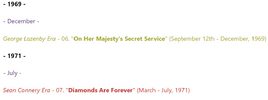
Correct. It wouldn't be the first time different 007 agents overlapped.

Lazenby's Bond is set between two Connery Era Films:

1764604431908.png

Then Sean's final Bond film is sandwiched between two Roger Moore Era films.

1764604471453.png
This is why I posit that 007 is not just one man, but multiple agents who share the alias "James Bond". Most of them are active all at once, taking up different aliases as the missions require (The Master episode 1.04 confirms this with Lazenby's Bond going by the name "Mallory". He even says that name is "as good as any" when the main character asks him "Is that the name you're still going by?") I know we've debated this point to death, but I still hold to it for reasons such as this.
 
Last edited:
Over the weekend I was able to watch perhaps the most action packed 007 flick yet, "Tomorrow Never Dies". What a ride! As for timeline notes, let's get into it.

At around the 25:20 mark, a newspaper dated "Friday 11, April 1997" can be seen.

1765205353022.png

At around the 27:06 mark, a car inspection sticker dated 11.97 can be seen.

1765205366067.png

At the 27:45 mark, a newspaper can be seen dated "Sunday 13, April 1997".

1765205382951.png

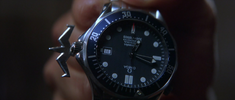
At around the 01:30:19 mark, James Bond's watch shows the date of "19".

1765205395311.png

Later, the same watch is shown with a date of "8", which isn't accurate UNLESS we insert a time jump from April 19th to May 8th between two scenes which the narrative doesn't seem to support.

1765205403596.png

So, with that evidence, we can confidently place this one in April of 1997.
 
Yesterday I was able to watch "The World Is Not Enough". Not my favorite 007 flick, but it does have a lot of timeline info, so let's get his one done.

Within the first few scenes, we already have a solid placement given to us with this document. At the 1:30 mark, a bank statement dated "15th November 1999" can be seen.

1765827592554.png

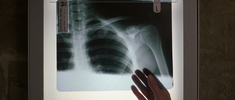
At the 19:07 mark, James Bond's X Ray is dated "20/11/99" (November).

1765827695532.png

At around the 47:06 mark, a check dated "7/12/99" (December) can be seen.

1765827793549.png

At the 1:04:35 mark, James Bond's watch can be seen with "11" as the date. It's likely that when Bond adjusts his watch for the grapnel, it pushed the day back one. At least that's my theory.

1765827893214.png

At the 52:55 mark, James Bond's credit card can be seen with an expiration date of "12/30 1998".

1765828128131.png

At the 54:27 mark, a car inspection sticker dated "99" can be seen.

1765828304246.png

In the Scottish MI6 headquarters, there is a painting on the wall of Sir Miles Messervy, the original "M" that debuted in "Dr. No". One thing us Code Name Theory folks can agree with the "it's the same guy" people on is the fact that since "Dr. No", we've been in the same universe and timeline. This franchise isn't known for having strong continuity, but it IS there if you pay close attention.

1765828390878.png

The final shot is set on New Years Day, which would place it on January 1st, 2000.

1765828578713.png

So, with all of that evidence, we can place Brosnan's third outing from November 15th, 1999 - January 1st, 2000.
 
Yesterday I was able to watch the comic book movie "Die Another Day". Not one of the best 007 flicks, but I had fun with it. This one had a bunch of timeline clues so let's get into Brosnan's final go as James Bond!

At around the 03:25 mark, James Bond's watch shows "16" as the date. I believe this is 01/16/2001 due to later timeline evidence. I couldn't find a screenshot, but it's during this scene:

1766415332633.png

It is revealed on-screen that James Bond was in North Korea for "14 months". That places us in March of 2002 if James entered North Korea in January of 2001.

1766415301476.png

At 40:47 an admission paper dated "1st March 2002, 8:00 a.m" can be seen. This document is what I believe places Bond's return from North Korea in March of 2002.

1766415361914.png

At around the 43:11 mark, a check dated "11.11.2002" can be seen. The same check can be seen at the 43:47 mark. So we've jumped eight months.

1766415378139.png

At the 43:47 mark, Jinx's date of birth, 08.08.73 can be seen. At the same time stamp, a document dated 03.03.02 can also be seen.

1766415522061.png

At the 44:34 mark, a computer screen contains the following text: "Therapy plan 5T active from 16.12.03." This would be December 16th, 2003. I'm not sure how to interpret this so any thoughts would be helpful. I'm going to assume the treatment plan will be completed on that date, but not sure.

1766415531702.png

It appears to be Spring when James Bond returns to Britain. Tulips can be seen in full bloom. Tulips season runs from the end of March until mid-May. So we've jumped about four months.

1766415614154.png

At the 01:07:48 mark, a case report dated "1/4/01" can be seen. This lines up with the beginning of the film being set in January of 2001.

1766415643285.png

A document dated "6.2.02" can be seen at the 01:08:11 mark. At the same time stamp Miranda Frost's dob can be seen. "7.3.73"

1766415674065.png

At the 01:37:40 mark, a license plate can be seen with "02" as the renewal year. This has to be out of date though, since we are in Spring of 2003 by this point.

1766415685685.png

So that's it for the timeline. I think we can safely say that the film opens on January 16th of 2001, then jumps to March of 2002. Then we jump to November of 2002 a bit later. Finally, we land in March/April of 2003 where the film ends.
 
Some more random notes from "Die Another Day".

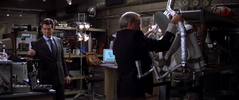
Several gadgets from "Octopussy" are seen in Q's lab: the AcroStar MiniJet, the crocodile submarine, the "magic rope" and the five-pointed knife, cementing that we are still in the same timeline as the Roger Moore Era.

1766416498559.png

007 picks up the Dagger Shoe from "From Russia With Love" and seems unfamiliar with it, lending credibility that this isn't the same 007 agent that was featured in the 1963 film and that we have been following the same continuity since the first movie "Dr. No".

1766416182732.png

The briefcase that contains a hidden knife from "From Russia With Love" is seen in Q's laboratory.

The Bell Rocket Belt from "Thunderball" is seen in Q's laboratory. Bond asks Q if it "still works" suggesting he's at least heard of it and knows it's old.

1766416598280.png

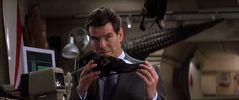
The yellow diving helmet from "For Your Eyes Only" is visible in Q's lab.

The electronic snooper from "A View To A Kill" is seen in Q's lab.

All very cool nods to the previous films.
 
Over the weekend I was able to binge four of the five Daniel Craig 007 films. Let's start with "Casino Royale", which had a TON of timeline clues!

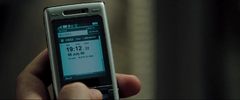
At the 10:15 mark, a cell phone shows the date being "06/07/06". This same phone can be seen at the 19:26 mark.

1767059498879.png
1767059537268.png

At the 20:58 mark, a webpage copyrighted 2006 can be seen. The calendar seen on the page lines up with November of 2006, but due to other evidence, this can be ignored.

1767059967594.png
1767059593047.png

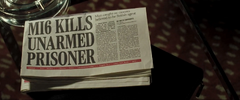
At the 23:27 mark, a newspaper headline reads "A shocking assassination of an unarmed prisoner was captured yesterday on CCTV at the embassy of Nambutu, Madagascar." This place is this scene on June 8th, 2006.

1767060114530.png

At the 28:15 mark, a cell phone can be seen with the date "06-July-06".

1767060168338.png

At the 28:38 mark, a security camera archive disc dated "July 6 - 2006" can be seen.

1767060218949.png

At the 28:48 mark, a cell phone can be seen with the date "06 July 06".

1767060243177.png

At the 42:19 mark, a cell phone can be seen with the date "06-Jul-06".

1767060332223.png

A webpage can be seen with the text "MIA Stock Price...On 28 June".

1767060452762.png
 
Continuing "Casino Royale":

At the 47:47 mark, a cell phone can be seen with the date "09-Jul-06".

1767060609356.png

A calendar can be seen at the 02:03:03 mark that matches both April and July of 2006. Since the previous and next months can be seen (March 31st and May 6th), it must be April. However, due to previous timeline evidence placing this film in July of 2006 it must be July.

1767060910193.png

At the 02:06:57 mark, a cell phone can be seen with the date "04-Aug-06". This can also be seen at 02:18:50.

1767061025859.png
1767060978299.png

And that's it for the fan favorite "Casino Royale"! We can confidently place this one in August of 2006. It begins months before that at an un-specified time.
 
And now for the divisive "Quantum Of Solace". Not much timeline evidence, but the narrative makes it pretty clear when it's taking place. This film picks up immediately after the events of "Casino Royale: Uncut Version".

Some of this 007 agents career info is revealed in one quick shot. He served in the Royal Navy from 1986 - 1995. He was in the RNR Defence from 1996 - 1999. He then began his career in MI6 in 1999. This means he was active in MI6 during the tenure of the previous "James Bond" 007 who was first introduced in "Goldeneye".

1767062215970.png

At the 35:28 mark, James Bond's date of birth can be seen. It's "APR 13 1968".

1767062154908.png

Camille Montes Rivero's driver's license can be seen at the 35:31 mark. It was issued "23-10-04" and expires "23-10-09". I couldn't find a pic of this shot, but it's from this scene:

1767061903957.png

By the end of the film, it's clearly winter due to the snowfall in Russia, meaning this film spans from August to November or December of 2006.

1767061796429.png

And that's it for this quite brief Bond flick. It picks up where the last one left off, on August 4th, 2006 and ends a few months later in the winter of the same year.
 

Attachments

  • 1767061557282.png
    1767061557282.png
    1.1 MB
Last edited:
Next up we have the excellent "Skyfall", infamous for featuring the franchises first F-bomb! M sure has a filthy mouth doesn't she?

The bulk of "Skyfall's" narrative takes place just three months after the film's opening scene due to the following dialogue: "Three months ago, you lost the computer drive containing the identity of almost every NATO agent embedded in terrorist organizations across the globe." The rest of the film takes place in the Autumn and Winter of 2011.

At the 01:42:29 mark, a car inspection sticker can be seen dated "30 04 12", which translates to April 30th, 2012.

1767062653688.png

And that's it! For a nearly two and a half hour film, there isn't much in the way of timeline info, but enough to place this one firmly in 2011, five years after the previous two.
 
Next up with have "SPECTRE". I'm still processing this one. The same feeling I had after seeing "The Last Jedi".

Not much to go on this one, in fact, I wasn't able to figure out the exact year. But the season is pretty easy to nail down.

The opening scene takes place on the Day of the Dead. The Day of the Dead is a holiday traditionally celebrated on November first and second, though other days, such as October 31st or November sixth, may be included depending on the locality.

Update: In 2015, Sun, Nov 1st – Mon, Nov 2nd was when this holiday was celebrated. So the film opens on either of these two days.

1767062944057.png

At the 22:25 mark, a order of temporary guardianship dated "21/01/1983" is seen.

1767063027350.png

So with that, we land in the month of November for the events of this film. If anyone can find any clues on what year it is, I'm all ears!

Update: I didn't realize this, but we have a year due to the next film's timeline. "No Time To Die" director Cary Joji Fukunaga has stated that his 007 film is set in 2020 and takes place exactly five years after "SPECTRE".
 
Last edited:
I have finally completed the 007 film series with "No Time To Die". Not much in the way of timeline info, besides this on-screen text which we can assume is five years after "SPECTRE".

1768243724038.png

The film also confirms when "Casino Royale" took place, 2006.

1768243744688.png
 

Latest posts

Back
Top