DC Animated Movie Universe - Timeline

The Comic Board - Collecting, Buy, Sell, Trade & Comic News, Reviews & Discussion

Help Support The Comic Board:

To me, GLTAS and YJ can be canon to each other with no issues. As most know, I'm pretty liberal when it comes to canonicity, so you're mileage may vary. These are the notes I took regarding episode 4.19 of YJ:

Dialogue indicates that Razer leaving Hal Jordan and Kilowog (as seen at the end of the "Green Lantern: The Animated Series" episode 1.26: "Dark Matter") occurred four years before the events of this episode. Metron saying it took Razer less than four years to lose hope may indicate that the time was being rounded up instead of down. This suggests the events of the "Green Lantern: The Animated Series" episode 1.26: "Dark Matter" ended in late Team Year Six (2017) or early Team Year Seven (2018). This doesn't line up, as the entirety of "Green Lantern: The Animated Series" has to occur before "Young Justice" due to the appearances of Guy Gardner and John Stewart, who are both introduced in that series for the first time (John Stewart is never seen.) Kilowog tells Razer "Four years. Four years! You don't call, you don't send subspace mail. And suddenly you're here wearing blue pajamas." Razer then states "Four years ago, I captured this Blue Ring's potent energy signal and tracked it to you." followed by "Shortly after we parted (at the end of "Dark Matter"), a blue lantern ring powered by hope found me in deepest space." This would place "Dark Matter" in 2017 which isn't possible due to the aforementioned Green Lantern's showing up in Season One. However, in "Dark Matter", Aya transports Hal Jordan back to the beginning of time and then returns in the "present day", which could theoretically be a different year (2017 in order to line up with this episode being in 2021).
 
To me, GLTAS and YJ can be canon to each other with no issues. As most know, I'm pretty liberal when it comes to canonicity, so you're mileage may vary. These are the notes I took regarding episode 4.19 of YJ:

Dialogue indicates that Razer leaving Hal Jordan and Kilowog (as seen at the end of the "Green Lantern: The Animated Series" episode 1.26: "Dark Matter") occurred four years before the events of this episode. Metron saying it took Razer less than four years to lose hope may indicate that the time was being rounded up instead of down. This suggests the events of the "Green Lantern: The Animated Series" episode 1.26: "Dark Matter" ended in late Team Year Six (2017) or early Team Year Seven (2018). This doesn't line up, as the entirety of "Green Lantern: The Animated Series" has to occur before "Young Justice" due to the appearances of Guy Gardner and John Stewart, who are both introduced in that series for the first time (John Stewart is never seen.) Kilowog tells Razer "Four years. Four years! You don't call, you don't send subspace mail. And suddenly you're here wearing blue pajamas." Razer then states "Four years ago, I captured this Blue Ring's potent energy signal and tracked it to you." followed by "Shortly after we parted (at the end of "Dark Matter"), a blue lantern ring powered by hope found me in deepest space." This would place "Dark Matter" in 2017 which isn't possible due to the aforementioned Green Lantern's showing up in Season One. However, in "Dark Matter", Aya transports Hal Jordan back to the beginning of time and then returns in the "present day", which could theoretically be a different year (2017 in order to line up with this episode being in 2021).
There's still the issue of Guy Gardner plus the mention of John Stewart.
 
In the extras section for Crisis on Infinite Earths: Part Three, they do make it sound like Earth-12, Earth-508 and Earth-2003 are the same from their shows, but they also make it sound like they could come back and will be fine, as is usual for comic book media.

New explanation:
1. The multiverse always existed paradoxically despite technically originating from Barry killing Darkseid. By killing Darkseid, he created a branched universe, which then created infinite realities. This is how Earth-2003 can interact with the DCAMU despite the DCAMU having not created it yet. It's just like how in Loki, the multiverse simultaneously was connected and separate from the MCU.

I guess this makes the DCAMU and Tomorrowverse something of a Earth-1A (Darkseid lives) and Earth-1B (Darkseid dies), since we were told it created a branch universe rather than a rewritten timeline.

2. Sometime after Justice League: Crisis on Infinite Earths: Part Three, I suppose the multiverse was restored by an animated convergence or Dark Crisis event. Unfortunately we don't get to see this, all we know is that they said that the DCAU, Teen Titans, etc. are fine.
 
Last edited:
Something that has been bothering me... Nolan North apparently plays John Constantine in Crisis on Infinite Earths: Part One. He sounds exactly like Matt Ryan though so I'm very confused. We heard him play Constantine in Beware My Power and he sounds very different.


This makes it seem like he believes he plays John in Part 2-3. We know he doesn't, Matt Ryan does. Is it possible that he was replaced with Matt at some point and they just kept the credits the same? Even Nolan North's British accent is completely different in this video. I believe that Matt Ryan does voice John in the finished film and you can't convince me otherwise.


Another organizational nightmare is that Mark Hamill didn't voice Joker in the physical media release of the film. I really, really hate that. In the streaming versions this is corrected, but I'm so annoyed that the version that you can own has the wrong guy.
 
This makes it seem like he believes he plays John in Part 2-3. We know he doesn't, Matt Ryan does.
I don't think he says or implies this? He gets asked about the two sequels but dodges the question.
 
Last edited:
I know that the DCAMU's Pre-Flashpoint timeline was actually supposed to be the DCAU before they scraped that idea (which is good because that's stupid), but I really wish they had canonized the non-elseworlds based films as Pre-Flashpoint. They work really well together as a timeline for the most part.

Here's my thinking here:
  1. Superman/Batman: Public Enemies references Superman's funeral.
  2. Superman: Unbound continues Supergirl's story after Superman/Batman: Apocalypse.
  3. Superman vs The Elite takes place after Superman: Unbound despite releasing before because it references Brainiac. It uses the same theme from Superman: Doomsday. It has a monitor showing a scene from Justice League: Doom. Ace of The Royal Flush Gang also appears on one of the monitors with the same design.
This is how I'd personally list them.

188? - DC Showcase: Jonah Hex
1971 - DC Showcase: The Spectre
2000 - Batman: Year One
2000 - DC Showcase: Catwoman
2007 - Superman: Doomsday
2009 - Wonder Woman
2009 - Green Lantern: First Flight
2010 - Justice League: Crisis on Two Earths
2010 - DC Showcase: Green Arrow
2010 - DC Showcase: Superman/Shazam! The Return Of Black Adam
2011 - Green Lantern: Emerald Knights (Sinestro rejoins Green Lantern Corp, lol)
2011 - Justice League: Doom
2012 - Superman/Batman: Public Enemies
2012 - Superman/Batman: Apocalypse
2013 - Superman: Unbound
2014 - Superman vs The Elite
2015 - Batman: Under the Red Hood
2015 - DC Showcase: Death in the Family
2017 - Justice League: The Flashpoint Paradox

Anyway, not actually canon. Maybe I'll cover every individual DCAOM film timeline one day, I don't know.
 
Last edited:
For anyone doing a complete watch through, Superman: Doomsday can probably be skipped in favour of the DCAMU's The Death and Return of Superman. Hypothetically, if one was to skip Doomsday... would All-Star Superman fit nicely into such a watch order instead, in 2016, say? Or is it still incompatible?
 
For anyone doing a complete watch through, Superman: Doomsday can probably be skipped in favour of the DCAMU's The Death and Return of Superman. Hypothetically, if one was to skip Doomsday... would All-Star Superman fit such a watch order, in 2016, say? Or is it still incompatible?
Why would you do that? This would place The Death and Return of Superman in the Post-Flashpoint timeline. Superman: Doomsday would be Pre-Flashpoint.

All-Star Superman is an Elseworlds in the comics too.
 
Your personal timeline's great, I'm just wondering how/if any of the other movies could fit into that sort of headcanon timeline. AFAIK Doomsday is a basically a condensed (and compromised?) take on the same story as Death and Return.
 
Last edited:
I know that the DCAMU's Pre-Flashpoint timeline was actually supposed to be the DCAU before they scraped that idea (which is good because that's stupid), but I really wish they had canonized the non-elseworlds based films as Pre-Flashpoint. They work really well together as a timeline for the most part.

Here's my thinking here:
  1. Superman/Batman: Public Enemies references Superman's funeral.
  2. Superman: Unbound continues Supergirl's story after Superman/Batman: Apocalypse.
  3. Superman vs The Elite takes place after Superman: Unbound despite releasing before because it references Brainiac. It uses the same theme from Superman: Doomsday. It has a monitor showing a scene from Justice League: Doom. Ace of The Royal Flush Gang also appears on one of the monitors with the same design.
This is how I'd personally list them.

188? - DC Showcase: Jonah Hex
1971 - DC Showcase: The Spectre
2000 - Batman: Year One
2000 - DC Showcase: Catwoman
2007 - Superman: Doomsday
2009 - Wonder Woman
2009 - Green Lantern: First Flight
2010 - Justice League: Crisis on Two Earths
2010 - DC Showcase: Green Arrow
2010 - DC Showcase: Superman/Shazam! The Return Of Black Adam
2011 - Green Lantern: Emerald Knights (Sinestro rejoins Green Lantern Corp, lol)
2011 - Justice League: Doom
2012 - Superman/Batman: Public Enemies
2012 - Superman/Batman: Apocalypse
2013 - Superman: Unbound
2014 - Superman vs The Elite
2015 - Batman: Under the Red Hood
2015 - DC Showcase: Death in the Family
2017 - Justice League: The Flashpoint Paradox

Anyway, not actually canon. Maybe I'll cover every individual DCAOM film timeline one day, I don't know.
I actually did the same years ago. I'll send you a link to my notes.
 
Your personal timeline's great, I'm just wondering how/if any of the other movies could fit into that sort of headcanon timeline. AFAIK Doomsday is a basically a condensed (and compromised?) take on the same story as Death and Return.
Yes, but this literally has them on separate but connected timelines. There's no reason to not include Doomsday because a different movie part of a different timeline has the same events happen.

You know when you watch Justice League: The Flashpoint Paradox? The timeline at the start is what I basically listed (with Doomsday), then there's the Flashpoint timeline, and at the end you have the New 52 timeline (with The Death and Return of Superman).

Batman/Superman: Public Enemies also references Superman having a funeral, which means the death of Superman event would have happened in that timeline. Once again, doesn't make sense not to list it if we're going in this direction.
 

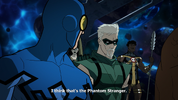
Kamandi, the Losers, Adam Strange (& Alanna) and Blue Beetle (& Nightshade, the Question and Captain Atom) all appear in JL:CoIE movies, and the Phantom Stranger and Death also get mentions (as mistaken identities) in CoIE Part One. I suspect all the recent DC Showcase shorts are actually canon to the Tomorrowverse.

Phantom Stranger.png

Death is better looking.png
 
Watchtower Database speculates that Earth-Prime Lois jumped realities to Earth-Caped Crusader for that cameo appearance, since she of course can do that because of the Council of Lois from My Adventures of Superman. I personally prefer that Batman: Caped Crusader is just a standalone thing that happens to also be set in Earth-Prime, but I get the idea they're going with.
 
I believe Batman Gotham Knight should be included in the DCAMU.

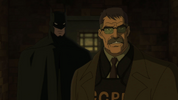
So for Gotham Knight I understand it's supposed to be canon to TDK trilogy, but that never worked for me. Too many atheistic differences and Kevin Conroy sounds nothing like Christian Bale. I think this fits far better with the DCAMU since we never really got much of Batman's backstory filled in. Now, I'm not saying this with no evidence to back up my claim. Here is what I think is the strongest evidence - James Gordon.

Here is Jim's design in Gotham Knight:

1753804807665.png

Now here he is a few years later in Son Of Batman:

1753804832962.png

Minus the grey temples and new glasses, it's the same model. As for timeline notes, here's what I got:

- This film takes places over the course of at least a month or more to give time for Bruce Wayne to upgrade his suit and vehicle.

- This film is set early in Batman's career. James Gordon is a Police Lieutenant by this time and Batman seems relatively new to the public.

- In the beginning scene of "Deadshot", Deadshot's watch reads "Fri 7.13" as the date, placing the ending of this film in July. Between 2000 and 2013, 07/13 fell on a Friday in 2001, 2007 and 2012. Since this is early in Batman's career, it's most likely July of 2001 or possibly 2007.

- The Scarecrow has faced Batman before this film.

- Killer Croc and Deadshot both face Batman for the first time in this film. Croc gets a "new" tail by the time of Son Of Batman. He doesn't have a tail in Gotham Knight.
 
I think that it's okay for you to view it that way, it's cool. Not for me personally though.
I also believe Green Lantern Emerald Knights is canon to the DCAMU.

Galius Zed is shown to be killed in one of the flashbacks to before the events of this film.

1753805639311.png

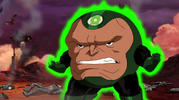
However, in the present day scenes another Noc'sagian Green Lantern can be seen during the final battle. It's most likely Cundiff Cood.

1753805700594.png

Then in Apokolips War, we see another Noc'sagian Green Lantern. It could easily be Cundiff Cood. Green Lanterns Galius Zed, Palaqua, and Salakk all perished in "Green Lantern: Emerald Knights" and yet seemingly appear in this film as corpses recently killed by Darkseid. This is the third film in which Salakk is killed. He was previously killed in both "Green Lantern: First Flight" and "Green Lantern: Emerald Knights". While this could be seen as a continuity error, an argument could be made that these Lantern's just happen to be the same species as those seen in the previous film. For instance, Cundiff Cood is also a Noc'sagian Green Lantern in the comics and could be the Noc'sagian that appears in this film. This theory is further backed by the Noc'sagian that appears in "Green Lantern: Emerald Knights" after it's shown that Galius Zed was killed already. The Slyggian who resembles Salakk could very well be Smithwick, who in the comics was a Yellow Lantern. Palaqua's race has yet to be identified, but the same rule applies.

1753805625869.png
 
I believe Batman Gotham Knight should be included in the DCAMU.

So for Gotham Knight I understand it's supposed to be canon to TDK trilogy, but that never worked for me. Too many atheistic differences and Kevin Conroy sounds nothing like Christian Bale. I think this fits far better with the DCAMU since we never really got much of Batman's backstory filled in. Now, I'm not saying this with no evidence to back up my claim. Here is what I think is the strongest evidence - James Gordon.

Here is Jim's design in Gotham Knight:

View attachment 3893

Now here he is a few years later in Son Of Batman:

View attachment 3894

Minus the grey temples and new glasses, it's the same model. As for timeline notes, here's what I got:

- This film takes places over the course of at least a month or more to give time for Bruce Wayne to upgrade his suit and vehicle.

- This film is set early in Batman's career. James Gordon is a Police Lieutenant by this time and Batman seems relatively new to the public.

- In the beginning scene of "Deadshot", Deadshot's watch reads "Fri 7.13" as the date, placing the ending of this film in July. Between 2000 and 2013, 07/13 fell on a Friday in 2001, 2007 and 2012. Since this is early in Batman's career, it's most likely July of 2001 or possibly 2007.

- The Scarecrow has faced Batman before this film.

- Killer Croc and Deadshot both face Batman for the first time in this film. Croc gets a "new" tail by the time of Son Of Batman. He doesn't have a tail in Gotham Knight.
I disagree with this because character models are borrowed and repurposed all the time. If it's loosely tied to the Dark Knight Trilogy (which btw, @Pro Bot please update that TDK timeline with the other tie-in comics that were unearthed) and that's all we know about it, it's essentially that. Not DCAMU.
 
I disagree with this because character models are borrowed and repurposed all the time. If it's loosely tied to the Dark Knight Trilogy (which btw, @Pro Bot please update that TDK timeline with the other tie-in comics that were unearthed) and that's all we know about it, it's essentially that. Not DCAMU.
But which universe do you think it fits more smoothly in?
 
I'm just watching the DCAU for the first time, over half way done w Batman: The Animated Series season 1 (watching on HBO Max, i know different streamers reordered episodes). i have heard about "Epilogue" from Justice League Unlimited and how it is considered "an ending" to the DCAU. i'm wondering if you all consider this an acceptable ending or if continuing past is worth it.
It's set after Unlimited in the Batman Beyond future, so yeah you can watch after it.
 
He's still Robin in the Teen Titans: The Judas Contract prologue set in 2011 but Nightwing by the time of Son of Batman in 2013. I don't know if there's any more precise date than that.
 

Latest posts

Back
Top